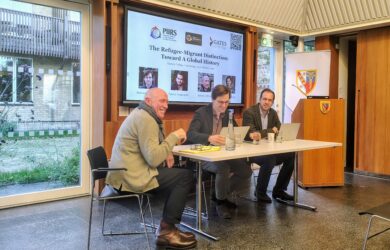


A video which features Gates Cambridge alumnus Alejandro Ganimian discussing the work he has done with the World Bank on benchmarking teaching policies around the world.
The Harvard Graduate School of Education (HGSE) has launched a video featuring a Gates Cambridge alumnus discussing his work on a World Bank project that benchmarks teacher policies around the world.
In the video, Alejandro Ganimian – currently a doctoral student in Quantitative Policy Analysis in Education at HGSE – presents the soon-to-be-released website for SABER (Systems Approach for Better Education Results), which includes data on teacher policies for over 70 education systems at the national and subnational levels, brief and user-friendly reports analysing these data according to eight core teacher policy goals and an online library with all the laws and regulations on teacher policies in these countries.
The project seeks to address a growing demand for information on teacher policies in both developed and developing countries, which has increased in recent years, as education systems around the world have become concerned with increasing the effectiveness of their teachers. The eight teacher policy goals which guide the data collection and analysis are: (i) setting clear expectations for teachers; (ii) attracting the best into teaching; (iii) preparing teachers with useful training and experience; (iv) matching teachers’ skills with students’ needs; (v) leading teachers with strong principles; (vi) monitoring teaching and learning; (vii) supporting teachers to improve instruction; and (viii) motivating teachers to perform.
While different successful education systems have emphasised some of these goals more than others, Alejandro says the response inside the World Bank has been “terrific” because in addition to the initiative being a useful tool for researchers and policymakers, it is really important for the Bank itself. This is because it has offices in virtually every developing country in the world and every time it gets a request to understand how the Finnish, or the South Korean, or the Chinese education systems work, the country office has to hire a consultant to do the research for them. He says: “The reports that result from these short-term hires are hardly ever exhaustive, they cannot be compared to others commissioned within the Bank and cannot be compared over time. For the first time in the Bank’s history, we are making this information available on the spot.”
Alejandro [2006], who did an MPhil in Education with the support of a Gates Cambridge Scholarship, is currently working with Harvard professor Thomas Kane, who is leading the Measures of Effective Teaching (MET) Project at the Gates Foundation. MET is a partnership of teachers, academics, and education organisations investigating better ways to identify and develop effective teaching.
He says: “I very much enjoyed working on the SABER-Teachers initiative because of the key role that I was allowed to play in every step of the project, from the design of the data collection instruments, to the development of the analytical framework and even in travelling with the World Bank to present this initiative to client countries around the world. Yet, most importantly, I was thrilled to be a part of this initiative because of the potential that it has to contribute to both systematic research about teacher policies and informed policy-making.”
The SABER project website is scheduled to be launched later in the year so the public can have access to the material.