

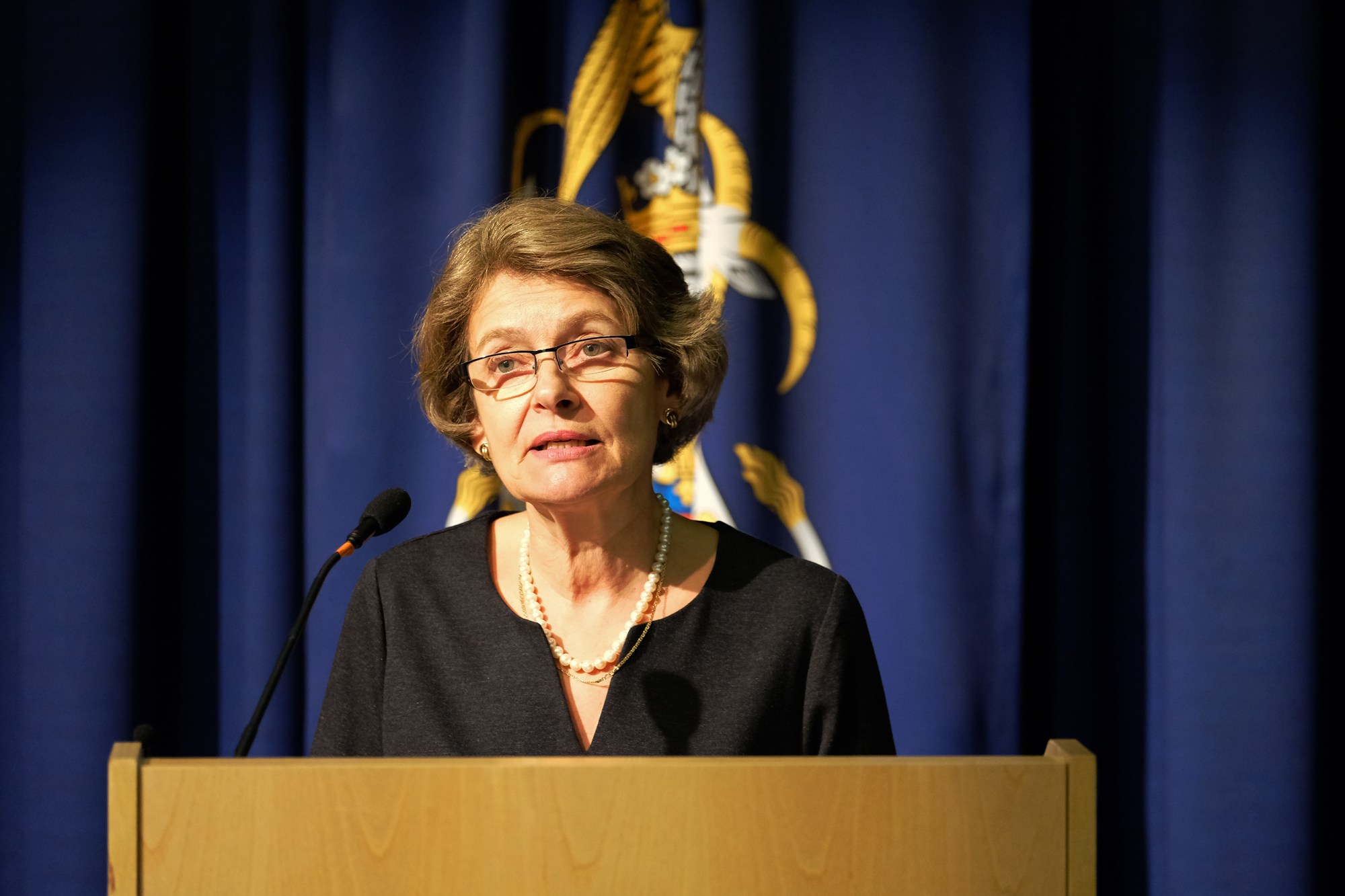
Irina Bokova delivered this year's Gates Cambridge Annual Lecture about the importance of cultural heritage.
When a World Heritage Site is destroyed anywhere in the world we are all diminished.
Irina Bokova
Cultural heritage is under threat from isolationism, extremism and xenophobia, but this has brought a new understanding of why it matters more than ever, Irina Bokova, the former Director General of UNESCO, said in her Gates Cambridge Annual Lecture yesterday.
In her lecture, Why Heritage Matters, Bokova said that while all cultures are different, awareness of and respect for those differences should unite people, not divide them. Culture is about more than bricks and stones, she stated. It is about how we understand the world, about intercultural dialogue as well as identity and belonging in a rapidly globalising world and, as such, it is as much about the past in as much it as about the future.
“Protecting world heritage is one of the most positive, visionary, transformative ideas that emerged in the last century,” said Bokova, citing the different conventions which have been enacted over the last decades.
There are 1,073 protected sites on UNESCO's World Heritage List, 31 of which are in the UK. Some of the first UK protected sites include the Giant’s Causeway and Stonehenge. The last site was the Lake District which was listed in 2017. “Each site is unique and each matters for all humanity and has outstanding human value,” she said.
Bokova, who was Director General of UNESCO from 2009-2017 and the first woman and Eastern European to head the organisation, spoke of how cultural heritage had come under threat from the rising tide of violent extremism and ‘cultural cleansing’. Culture is now on the frontline of modern conflict with extremists aiming to erase history and identities by destroying it. She spoke in particular of the destruction of cultural heritage sites in Mali, Iraq and Syria and of illegal trafficking in antiquities.
She stated: “When a World Heritage Site is destroyed anywhere in the world we are all diminished, even if it is from another region, another period, another culture, another religion.”
A key security issue
Threats to cultural heritage have not only brought a new understanding of why it matters, but an awareness of how it cannot be delinked from the protection of human lives. Protecting cultural heritage is now a key security issue, said Bokova. Developments such as the setting-up of a training programme for judges and prosecutors on trafficking in antiquities and links with money laundering and corruption as well as joint approaches to tackling the looting of antiquities in Syria are evidence of this new approach.
She added that cultural heritage is not only a victim of war, but it is a tool for peace, social transformation, reconciliation and healing. She spoke of examples such as the reconstruction of the mausoleums in Mali and the Mostar Bridge in Bosnia. She said these gave a message that culture “can foster rebirth, reconcile and heal”.
War is not the only threat to cultural heritage, said Bokova. Climate change, mass tourism and urbanism are just some of the other challenges facing organisations seeking to protect heritage.
She spoke too of the need for a new education of cultural literacy and mutual respect and understanding of cultural diversity, of the vital role of the humanities in fostering values and ethics and of how cultural heritage is a key factor in moves towards sustainable development, providing decent local jobs.
Cultural heritage is fundamentally about our common humanity, said Bokova. “There is no pure culture. No culture has flourished in isolation,” she stated. “They have always mingled and enriched each other… Education and culture allow us to see the world not just as it is, separate and distant, but as part of each of us.”
You can watch the full lecture on our YouTube channel.