

Susannah Hollister is co-editor of a new edition of Stein's Stanzas in Meditation.
The first book to confront the complex story of how a key work by Gertrude Stein was composed and revised has been co-edited by a Gates Cambridge alumna.
Susannah Hollister [2001], currently ACLS New Faculty Fellow at the University of Texas at Austin, is co-editor of Gertrude Stein’s Stanzas in Meditation: The Corrected Edition, published by Yale University Press.
In the 1950s Yale University Press published a number of Gertrude Stein’s posthumous works, among them Stanzas in Meditation. Since that time, scholars have discovered that Stein’s poem exists in several versions: a manuscript that Stein wrote and two typescripts that her partner Alice B. Toklas prepared. Toklas’s work on the second typescript changed the poem when, enraged upon detecting in it references to a former lover, she not only adjusted the typescript, but insisted that Stein make revisions in the original manuscript.
Yale says the new edition of Stanzas in Meditation is the first to confront the complicated story of the collection’s composition and revision and presents a reliable reading text of Stein’s original manuscript, as well as an appendix with the textual variants among the poem’s several versions. Yale says: “This record of Stein’s multi-layered revisions enables readers to engage more fully with the author’s radically experimental poem and also to detect the literary impact of Stein’s relationship with Toklas. Students and admirers of Stein will welcome this illuminating new contribution to Stein’s oeuvre.”
The book was recently reviewed in the New York Times where author Lynne Tillman said: “The editors Susannah Hollister and Emily Setina, literary sleuths, have done significant work restoring this book.”
The Editors’ Choice section of the New York Times Books Review has included the book on its list.
Susannah did a CPGS in the History of Art at the University of Cambridge, funded by a Gates Cambridge scholarship.
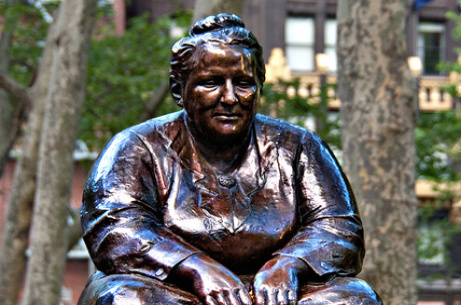
Picture credit: Tattooed JJ and creative commons.