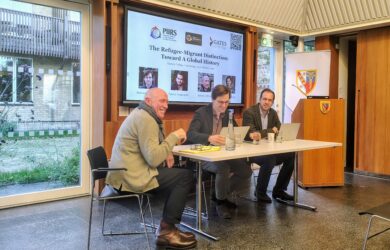


Ramit Debnath and Sandile Mtetwa took part in a Cambridge Alumni Festival discussion on the transition to renewable energy
Context matters when it comes to the transition to renewable energy and researchers need to work with local people on the ground to ensure that associated technologies work better, a Cambridge Alumni Festival heard at the weekend.
The Building an energy revolution discussion put the spotlight on the energy transition from fossil fuel needed to address the global climate crisis.
The speakers were Ramit Debnath [2018], a Gates Cambridge Scholar and computational scientist who focuses on energy and climate justice in the built environment, Sandile Mtetwa [2017], another Gates Cambridge Scholar who researches green hydrogen, and Alison Smith, Professor of Plant Biochemistry in the Department of Plant Sciences at the University of Cambridge.
Each outlined their area of research. Mtetwa’s work assesses the performance of metal organic frameworks as catalysts in the process of creating green hydrogen, which she hopes will provide insights into more applicable ways of forming green hydrogen.
Debnath spoke of his work on energy justice with vulnerable communities in Nigeria, Brazil and India and how he brings together machine learning and local people’s voices to help policymakers make better decisions.
Professor Smith spoke of her work on algae to provide sustainable alternatives in processes ranging from carbon capture to waste remediation.
The panellists, chaired by Professor Stephen Toope, Vice-Chancellor of the University of Cambridge, spoke about what clean energy means for them and about the need for any renewable energy strategy to take account of individual contexts, for instance, differing energy access and security issues in Africa, infrastructure issues and energy poverty in India.
Mtetwa is the Zimbabwe partner for a company in Cambridge which focuses on biogas production. She said it is important for partners in the North to engage with local people before introducing new technologies so they can understand their needs. That includes training regarding maintenance of any alternative technology. People need to feel some sense of ownership of new technologies and can then adapt them to their local context and innovate, she said.
Another part of the discussion focused on how to make alternative energy more affordable as well as how to get people in the North to consume less. Mtetwa said more investment was needed to make green hydrogen cheaper than blue hydrogen from non-renewable energy sources. Debnath called for international collaboration on technology transfer. Transfer should be a two-way process, he said.
Asked how a balance could be achieved between the South’s need to industrialise and the global need to drive down carbon emissions, Mtetwa said countries in Africa, which accounts for less than 3% of global carbon emissions, have to continue to industrialise, but renewables should be part of their energy mix. Debnath said there international policymakers need to be more aware of all the different contexts involved when it comes to their strategies for driving forward alternative energy.
Other issues covered in the discussion included the circular economy, sustainability funding, co-creation of solutions, behavioural nudges towards renewable energy use, natural gas as an energy transition fuel and the need for incentives rather than conditionality.
Asked if they were optimistic about the future all the speakers said they were cautiously optimistic. Debnath believed there would be a snowballing effect when it came to reducing carbon emissions. Mtetwa said the biggest bottleneck was economic and political will. Professor Smith added that there was a recognition that things have to change. “Covid has shown us that things can change more rapidly than we imagine,” she said.
Education
The Alumni Festival event is part of a series of Gates Cambridge discussions for the scholarship’s 20th anniversary, including a recent Mind Over Chatter podcast on access and inclusion in the education system with Gates Cambridge Scholars Aya Waller-Bey [2015, Education] and Arif Naveed [2014, Education] and Sara Allan, Director of Early Learning and Pathways at the Bill & Melinda Gates Foundation.
In the podcast, Arif Naveed explored how the underlying social hierarchy that shapes day-to-day living also impacts the economic outcomes of schooling. Aya Waller-Bey talked about quality as opposed to simple access to education and Sara Allan questioned whether a more student-centred approach would improve access and inclusion in schools.
*Picture credit: Some of the wind turbines and power station near the top of the Ngong Hills, Kenya, courtesy of Wikimedia commons.