



Melisa Basol is lead author of a study which shows that an online game can successfully 'inoculate' players against fake news.
We conclude that, compared to a control group, the generalised inoculation intervention not only successfully conferred resistance to online manipulation, but also boosted confidence in the ability to resist fake news and misinformation.
Melisa Basol, Sander van der Linden and Jon Roozenbeek
Gates Cambridge Scholar Melisa Basol is first author on a paper which shows that online fake news can be countered successfully using a game which teaches people about misinformation techniques.
Bad News is an online choice-based game that encourages the players to walk in the shoes of a “fake news tycoon”. Players learn about the six most common strategies used to produce and spread fake news.
The study, published today in The Journal of Cognition, builds on previous research on the game by replicating findings in a randomised control trial and including measures of attitudinal certainty.
It measured participants’ ability to spot misinformation techniques in 18 fake headlines before and after playing Bad News and finds that playing Bad News significantly improves people’s ability to spot misinformation techniques compared to a gamified control group. Crucially, it also increases people’s level of confidence in their own judgments, although this confidence boost only occurred for those who correctly adjusted their reliability assessments.
Also none of the main effects revealed an interaction with political ideology, suggesting that the intervention works as a “broad-spectrum” vaccine across the political spectrum.
Bad News is part of an approach to fake news that builds attitudinal resistance against online misinformation through psychological inoculation. The idea is that, by pre-emptively exposing people to weakened doses of misinformation, cognitive immunity can be conferred.
The researchers, Melisa [2018], who is doing a PhD in Psychology, Jon Roozenbeek and Sander van der Linden from the Department of Psychology's Social Decision-Making Research Lab, say: "We conclude that, compared to a control group, the generalised inoculation intervention not only successfully conferred resistance to online manipulation, but also boosted confidence in the ability to resist fake news and misinformation."
*Picture credit: A stack of newspapers c/o Daniel R. Blume from Orange County, California, USA and Wikimedia Commons.
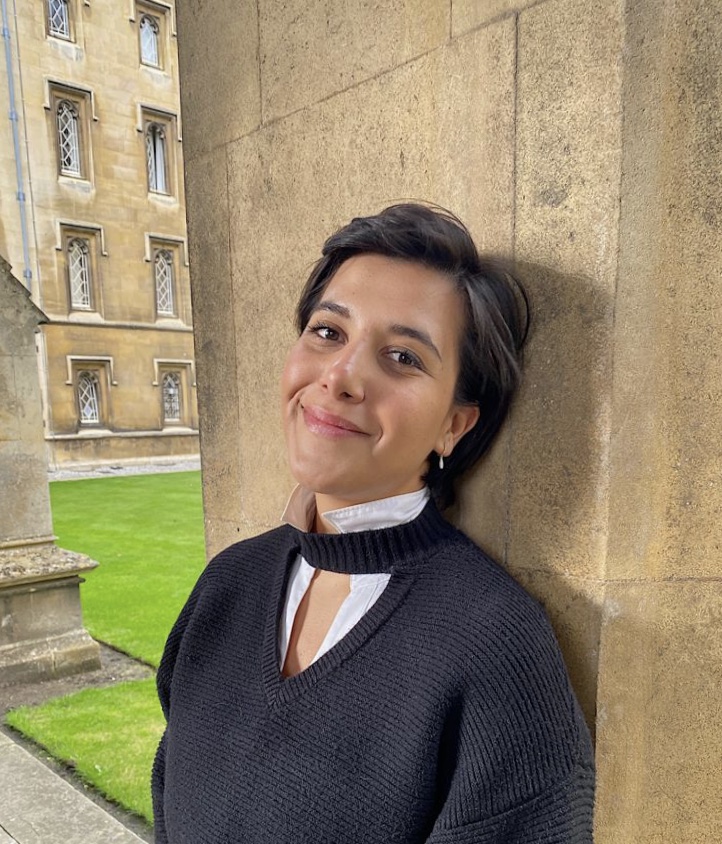
Melisa Basol
- Alumni
- Germany
- 2018 PhD Psychology
- Pembroke College
Dr Melisa Basol is a Social Psychologist and part of the 2022 Class of Forbes 30 under 30.
In collaboration with the UK Cabinet Office (and supported by UNESCO, UN, and WHO), Melisa co-developed 'Go Viral!', a gamified intervention to combat the threat posed by COVID-19 misinformation and conspiracies. 'Go Viral!' has been played over 1.5 million times since it's launch and is now available in 10+ languages.
Melisa also collaborates with the Stanford Health Communication Initiative and Duke University's efforts to fight vaccine hesitancy. She enjoys public engagement (e.g., BBC World, TedX) and continues to advise governmental institutions (e.g. EU Commission, NATO) on evidence-based policy-making.
As a Gates Scholar at the University of Cambridge, she read Psychology and focused on persuasion and resistance against misinformation through inoculation theory. Alongside numerous peer-reviewed scientific publications, Melisa was also awarded the WhatsApp Research Grant for Misinformation to help develop, test, and launch interventions against the spread of harmful misinformation on WhatsApp in India, Brazil, and the UK.
Previous Education
University of Wales, Aberystwyth
University of Cambridge